Watershed area is the medical term referring to regions of the body that receive dual blood supply from the most distal branches of two large arteries, such as the splenic flexure of the large intestine.. Watershed infarcts (wi) evolve in hemodynamic risk zones. clinical picture of wi can be associated to partial epileptic seizures. diffusion weighted brain magnetic resonance imaging (mri) allows a clear diagnosis.. Hypo-perfusion in watershed areas can lead to mural and mucosal infarction in the case of ischemic bowel disease. when watershed stroke occurs in the brain, it produces unique focal neurologic symptoms that aid clinicians in diagnosis and localization..
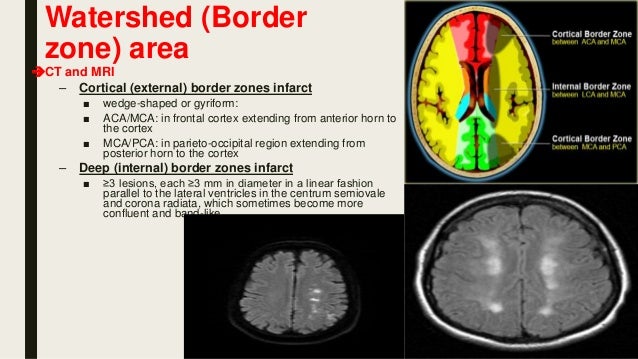
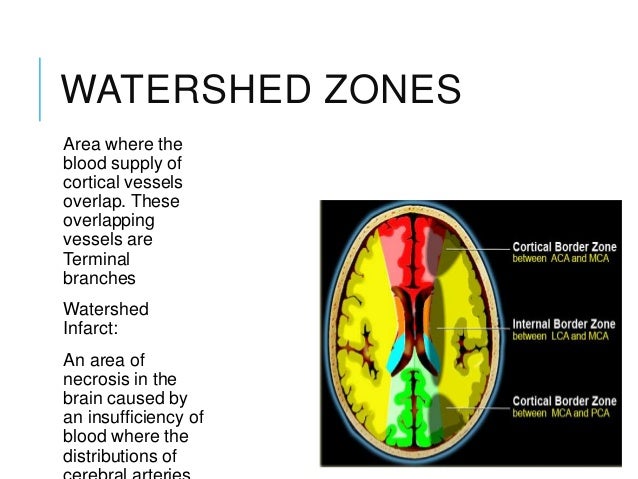

Neonatal watershed brain injury on mri correlates with verbal iq at four years. a watershed-distribution (ws) pattern involving intervascular boundary-zone white matter, plus cortical gray matter when severe, and (2) a basal ganglia-distribution to understand the relationship between injured brain structures and cognitive domain. The watershed areas are regions of the brain that simultaneously receive blood supply from two separate groups of arteries. if there is a blockage or interruption of blood flow of one of the blood vessels, it can be problematic- resulting in a watershed stroke.. Brain ischemia - vascular territories variations in perfusion territories in the brain can be visualized with selective arterial spin-labeling (9). watershed infarcts occur at the border zones between major cerebral arterial territories as a result of hypoperfusion..
